

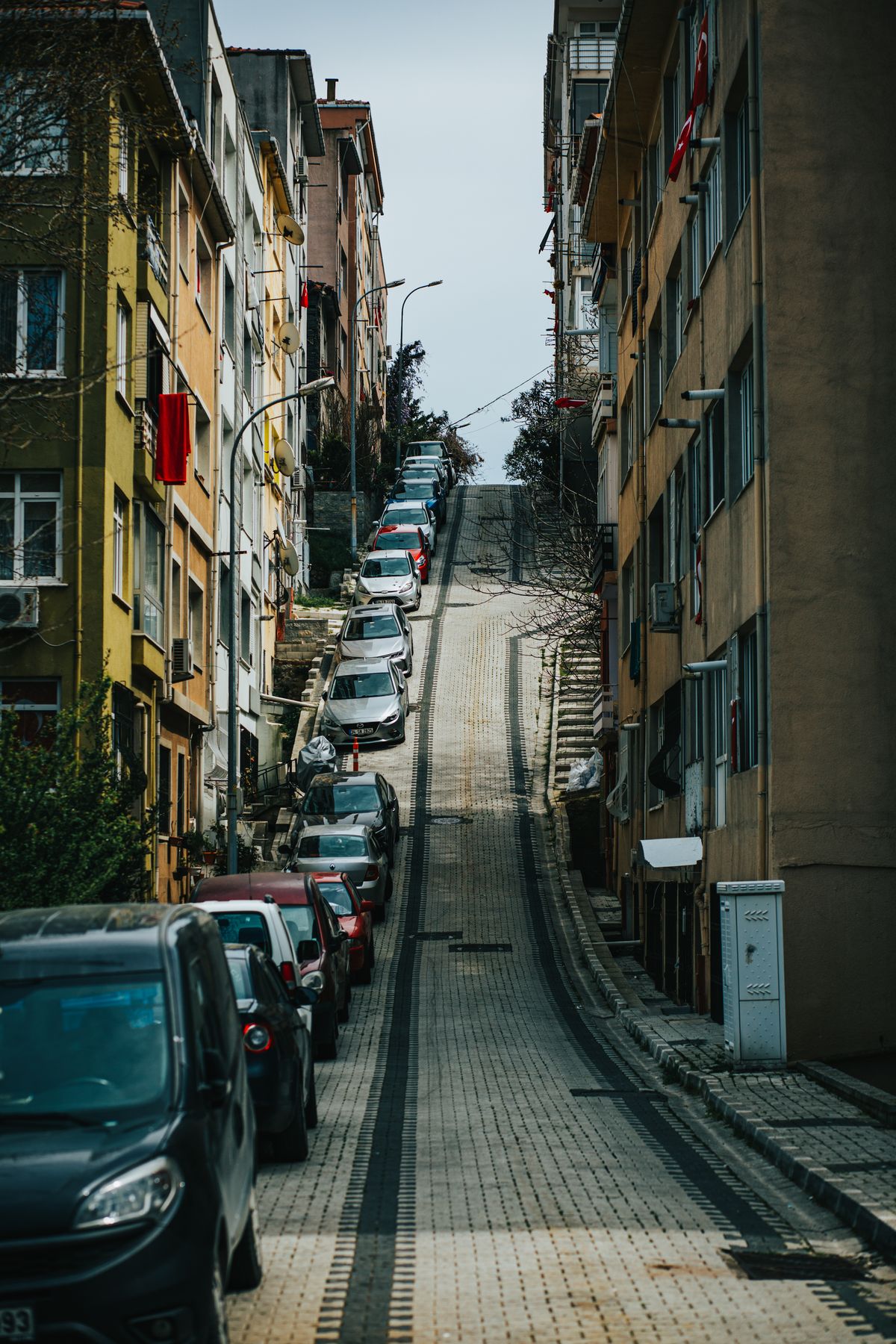
Three rules, and most drivers remember two of them backwards.
Parking on a hill is on the written test in most places and on the road test in a lot of them, and it keeps turning up because the consequence of getting it wrong is a vehicle rolling into traffic with nobody in it. Here is the whole thing, including the case almost every article skips.
The three rules
| Situation | Which way the front wheels go |
|---|---|
| Headed downhill, curb present | Into the curb, meaning right, toward the side of the road |
| Headed uphill, curb present | Away from the curb, meaning left, toward the centre of the road, then roll back until the wheel touches the curb |
| Either direction, no curb | Right, so the vehicle rolls away from the centre of the road |
Those are the rules as the California driver handbook states them. The Manitoba handbook gives the same three, which is worth knowing because this is one of the few driving rules that does not change much when you cross a border.
There is a fourth case that gets left off most lists. On a sloping driveway, turn the wheels so the vehicle will not roll into the street, leave it in park and set the brake. Which way that is depends on which way the driveway slopes, so there is no fixed answer to memorise.
Stop memorising and understand the one idea
You do not need three rules. You need one question: if the brakes let go right now, where does this car end up?
Everything follows from that.
Downhill with a curb. Gravity is pulling the car forward, down the slope. Point the front wheels into the curb and the front tyre wedges against it as the car creeps forward. The curb becomes a chock.
Uphill with a curb. Gravity is pulling the car backward. Pointing the wheels into the curb does nothing, because the car is not travelling that way. Turn them away from the curb instead, and as the car rolls back the tyre swings in and catches on the curb. This is why the instruction includes rolling back a few inches: you are seating the tyre against the curb rather than leaving it a foot away and hoping.
No curb, either direction. There is nothing to catch the tyre, so the aim changes. You are no longer trying to stop the car. You are choosing where it goes. Wheels to the right sends it off the road rather than into oncoming traffic, whichever way it rolls.
That last one is the rule people get wrong, and it is the one that matters most, because it is the situation with no safety net.
The part that is not about the wheels
Wheel direction is the last step, not the whole job. Both handbooks put the same instructions ahead of it.
Set the parking brake, firmly. On a slope the brake is doing real work rather than sitting there as a formality.
Automatic transmission goes in park.
Manual transmission goes in gear. Manitoba is more specific and says reverse or low gear. The logic is the same as the wheel rule: you want the engine’s compression resisting the direction gravity is pulling.
The order matters more than people think. Set the parking brake before you take your foot off the service brake, and before you shift into park. Doing it the other way round parks the whole weight of the car on the transmission, which is what makes that clunk when you shift out of park on a hill.
Is it actually illegal, or just advice?
Both, depending on where you are standing, and this is the part a driving school page will not tell you.
In California the relevant section is Vehicle Code 22509. It does not ban the behaviour outright. It says that local authorities may adopt rules by ordinance or resolution providing that nobody may leave a vehicle standing unattended on a grade exceeding 3 percent, within a business or residence district, without blocking the wheels by turning them against the curb or by other means.
Read that carefully, because three things fall out of it:
- It is a local rule, not a blanket state one. Whether you can be cited depends on whether your city adopted an ordinance
- It applies above a stated steepness, 3 percent, and inside business or residence districts. A rural road on a slight incline is a different situation
- Turning the wheels against the curb is given as one method. The wording allows other means, which is what makes wheel chocks acceptable where the geometry will not cooperate
Other states and provinces write their own versions, and the steepness threshold and the districts covered are the parts that vary. The safe approach is the handbook rule everywhere and the statute check where you actually live, because the citation is written against your local code. We went through the same point about curb distance in positioning your curbside wheels, where the required gap is also set state by state.
Where the real exposure is
A ticket for an unchocked wheel is a nuisance. A vehicle that rolls is something else, because once it moves you are into liability rather than a fine. The vehicle was unattended, so there is no argument about who was driving, and the rule you did not follow is written down in the handbook you were tested on.
This is also why rental and work vehicles are worth a second of extra care. You may not know how strong that parking brake is or how worn it is, and the wheel position is the only part of the system you can see working.
Hills, parking and the rest of the rules
Two related things worth keeping straight, since they come up on the same tests.
Meeting another vehicle on a steep narrow road. The vehicle facing uphill has the right of way. The one facing downhill backs up, because it has more control reversing up the slope than the uphill vehicle has reversing down it.
The distances that apply on a hill the same as anywhere. A slope does not suspend the ordinary parking restrictions. In California that means not within 15 feet of a fire hydrant or a fire station driveway, not within 20 feet of a crosswalk marked or unmarked, not within 15 feet of a crosswalk where a curb extension is present, not within three feet of a sidewalk ramp, and not blocking a sidewalk or driveway even partly. A steep street with few legal spaces is exactly where people talk themselves into one of these.
If you want the broader set, we listed them in the parking laws worth knowing, and what happens when a citation goes unpaid is covered in our piece on unpaid parking tickets.
A thirty second check before you walk away
- Which way is the slope pulling the car?
- Is there a curb?
- If yes: downhill points the wheels into it, uphill points them away and then rolls back onto it
- If no: wheels right, both directions
- Parking brake on first, then park or in gear
- Look at the front tyre. You should be able to see which way it is turned from outside the car
That last step is the one that catches mistakes. The wheel position is visible from the pavement, so you never have to trust your memory of what you just did.
Common questions
Into the curb, which means turning them right toward the side of the road. As the car creeps forward the front tyre wedges against the curb and stops it.
Away from the curb, which means left toward the centre of the road, then let the vehicle roll back a few inches until the wheel gently touches the curb. Rolling back matters, because it seats the tyre against the curb instead of leaving a gap.
To the right, whether you are facing uphill or downhill. With no curb to catch the tyre you cannot stop the car, so the aim is to send it off the road rather than into the centre of it if the brakes fail.
It depends on local law. In California, Vehicle Code 22509 lets local authorities adopt ordinances requiring the wheels to be blocked on a grade exceeding 3 percent in a business or residence district. So whether you can be cited turns on your own city or state code rather than on one national rule.
Both, and in that order. Set the parking brake before shifting into park, or into gear on a manual. Shifting first leaves the weight of the car resting on the transmission, which is what causes the clunk when you shift out of park on a slope.
The vehicle facing uphill. The one facing downhill should back up, because it has more control reversing up the hill than the uphill vehicle has reversing down it.


